



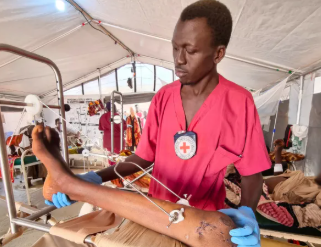
The International Committee of the Red Cross (ICRC) on Friday said that amid ongoing conflict in several parts of South Sudan, medical and humanitarian personnel are facing significant challenges in reaching the wounded and the most affected communities.
A press statement extended to Radio Tamazuj said in late 2025 and early 2026, armed conflict intensified further in several regions of South Sudan, particularly in Jonglei, Eastern and Central Equatoria states.
“Ongoing access constraints in certain areas of South Sudan mean that the ICRC cannot reach several weapon-wounded patients in need of life-saving medical care” said Daniel Bunnskog, the head of International Committee of the Red Cross (ICRC) delegation in South Sudan. “We call on parties to the conflict to allow and facilitate the rapid and unimpeded passage of humanitarian aid to civilians in need and those wounded by weapons, and to respect and protect humanitarian personnel carrying out impartial humanitarian activities.”
The ICRC reminded all parties to the conflict of their obligations under international humanitarian law (IHL), in particular the need to clearly distinguish between civilians and persons taking a direct part in hostilities, as well as between civilian objects and military objectives.
“Civilians must never be the object of attack. The wounded, sick, and those detained in relation to the conflict must be respected and protected in all circumstances and must receive medical care without delay and without discrimination,” the statement reads in part. “Medical personnel, medical facilities, and medical transports must be respected and protected in accordance with international humanitarian law (IHL).”
According to the statement, the ICRC engages in bilateral dialogue with the parties to the conflict to address the humanitarian situation and to reiterate their obligation to respect international humanitarian law (IHL), including to ensure safe access for our teams to help weapon wounded in need of life-saving care.
“We continue providing neutral, impartial, and independent humanitarian support to those affected by the consequences of the armed conflict in South Sudan,” the statement concluded.

 and then