



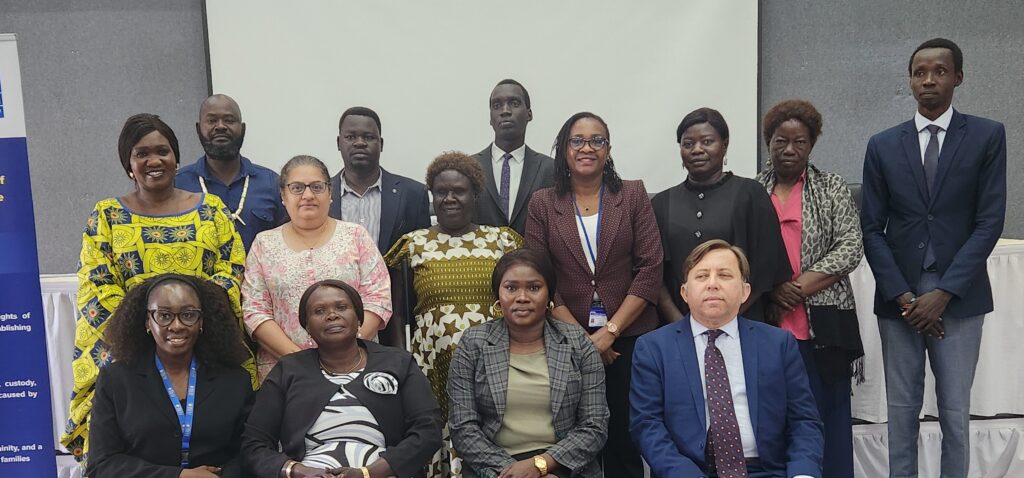
The South Sudan Ministry of Gender, Child, and Social Welfare opened a three-day public participation workshop in Juba on Tuesday to review the Family Law Bill, which aims to address long-standing legal gaps affecting families across the country.
The consultations, supported by the United Nations Development Programme (UNDP) and funded by the Kingdom of the Netherlands, have drawn government officials, civil society groups, traditional leaders, and development partners to gather public input on proposed reforms to marriage, divorce, inheritance, and child custody laws.
Speaking during the opening of the consultation workshop, Esther Ikere Eluzai, the Undersecretary at the Ministry of Gender, Child and Social Welfare, described the ongoing public consultations on the Family Law Bill as “the most awaited” legal process in South Sudan, noting that the country urgently needs the legislation to address long-standing family-related disputes.
Ikere said the bill is “one of the most important legislations in the country,” aimed at closing legal gaps around marriage, divorce, child custody, inheritance, and family rights.
She stressed that the absence of a unified family law has left women and children particularly vulnerable, especially in cases of child marriage, forced marriage, domestic violence, and property disputes.
“When we do not have legislation for the basic unit of society, our social fabric becomes loose,” she said.
Ikere said the ministry is opening the draft bill for public input for the first time and called for a unified approach, warning against parallel versions of the law.
“We want to use one draft and enrich it together, because having different legislations is not good for us,” she emphasised.
She outlined a roadmap that includes incorporating public feedback, lobbying parliament, raising public awareness through radio programs, and submitting the final draft to the Ministry of Justice before it is tabled in parliament.
Meanwhile, Brenda Ambani, a Rule of Law Specialist at the United Nations Development Programme (UNDP), said the public consultation on the Family Law Bill marks a critical step toward strengthening the rule of law and promoting social justice in South Sudan.
“This bill is not just another piece of legislation, but a cornerstone for building a fair and inclusive society,” she noted.
Ambani highlighted that family matters in South Sudan have long been governed by a mix of customary, religious, and statutory laws, creating legal uncertainty, particularly for women, children, and other vulnerable groups.
She said the bill aims to establish clear and uniform legal standards, protect women’s and children’s rights, promote gender equality in marriage, divorce, and inheritance, and harmonise customary and statutory legal systems across the country.
Ambani stressed that the workshop is more than a technical exercise, but a platform for dialogue, inclusivity, and consensus-building, and urged participants to contribute meaningfully.
“Your voices matter, because you are here on behalf of the people of South Sudan,” she said.
For her part, Jocelyn Oboy Itorong, Senior Gender Advisor at UN Women, said the Family Law Bill is critical to the everyday lives of South Sudanese families, especially women and girls.
“Family law is not just a matter of legal text; it governs marriages, divorce, inheritance, custody and protection,” she said, noting that strong and equitable laws are essential to ensuring “dignity, equality and justice.”
“This is an opportunity to listen, learn, and build consensus around a framework that protects rights and strengthens social cohesion,” Oboy added.
She reaffirmed UN Women’s commitment to supporting the process, saying the bill could become “a foundation for stronger families, healthier communities and a more just and inclusive South Sudan.”

 and then