



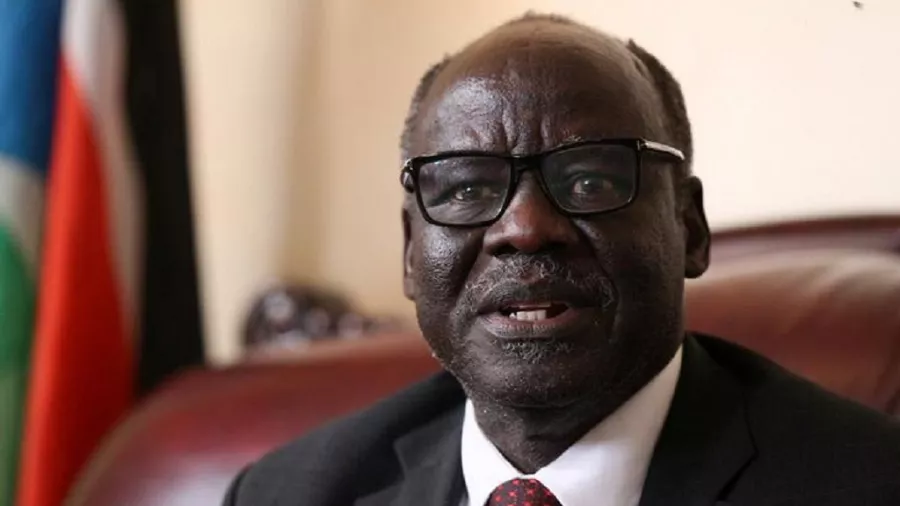
South Sudanese politician Dr. Lam Akol Ajawin has rejected claims by a splinter group within the opposition National Democratic Movement (NDM) that it removed him as party leader, calling the move baseless and procedurally invalid.
The group, led by former party secretary general Mahjoub Biel Turuk, announced on Wednesday that it had ousted the veteran politician, accusing him of repeatedly violating party rules and undermining internal democracy.
The announcement was made at a press conference in Juba, where the splinter group said the decision had been taken by the party’s highest decision-making body following consultations and internal reviews.
“The National Democratic Movement announces the removal of Dr Lam Akol Ajawin from the office of the party,” a member of the group, Lomude, said.
Responding to the claims on Thursday, Dr. Akol dismissed accusations that he had overstayed his term as party leader, describing them as “a total fabrication”.
“Nobody among them spoke to me about that,” he said, insisting that any discussion on leadership tenure could only be handled by the National Delegates’ Conference (NDC), the party’s highest authority.
He challenged critics to name any political party in South Sudan whose constitution clearly defines both term limits and age limits for its leadership, saying the issue could only be debated through established party structures.
“If it were raised, we would discuss it,” Akol said, noting that the NDC is scheduled for June, about four months away. He accused the splinter group of acting in bad faith, saying the move was “for consumption” and “not a genuine thing”.
Akol also rejected allegations that he had filled party positions with members of his own Chollo tribe, calling the claim factually incorrect. He cited several NDM members who have served as lawmakers and senior officials from different regions, including Peter Lomude Francis from Central Equatoria, arguing that the party’s leadership reflects South Sudan’s diversity.
“If you give the names, you will see there is no place which is not represented,” he said. “So that claim does not stand on its feet.”
On the legality of his purported removal, Akol said only the National Delegates’ Conference has the authority to discipline or remove the party chairperson. He said party rules clearly state that the NDC alone can “discipline the chairperson or relieve him if he has exceeded his powers”.
He added that the NDC had already been convened for June, following a resolution by the National Leadership Council in August, and argued that removal was unnecessary in any case since all party officials automatically resign once the conference convenes.
“When the National Delegates Congress is held, you don’t even need to remove the chair,” he said. “Everybody who is holding an office in the NDM resigns and the new leadership is elected.”
Addressing accusations that he made unilateral internal appointments, Akol said most party positions are filled through elections rather than appointments. He said the National Delegates’ Conference elects the National Leadership Council, which then elects the National Executive Committee.
He said some of the officials now opposing him had contested for leadership positions and lost heavily. “A former secretary general took only 15 votes out of 100,” he said, adding that another senior official secured just 16 votes.
Akol also denied claims that he controlled government nominations, saying parliamentary and ministerial nominees in 2020 were selected collectively by the party leadership.
“They selected themselves,” he said. “I have no hand in selecting them.”
On the broader political context, Akol said the NDM’s commitment to South Sudan’s 2018 peace agreement was not dependent on holding government positions. He recalled that his removal from ministerial posts had not affected his position as party chairperson or the party’s stance on the deal.
“Our commitment to the peace agreement is not conditional on positions,” he said, accusing other parties of undermining the accord by recruiting members from rival movements.
“Action speaks louder than words,” he added.
Akol said the NDM would continue to participate in the peace process regardless of political developments. “After today we are part of the agreement. After tomorrow we are part of the agreement,” he said.
Meanwhile, party spokesperson Kai Tap accused Peter Lomude Francis and Mahjoub Biel Turuk of focusing on internal fights instead of recruiting new members, in a statement read to journalists.
The dispute within the NDM comes amid a pattern of splits and internal crises affecting several South Sudanese parties, particularly those signatory to the 2018 peace agreement. It follows recent complaints by the NDM that the ruling Sudan People’s Liberation Movement (SPLM) had begun taking positions allocated to it under the accord.
Akol was removed as transport minister in October 2025 by President Salva Kiir after serving five months in the role.
A long-time critic of Kiir, Akol founded the NDM in 2016 after previously leading the SPLM-Democratic Change party, which he formed following a split from the SPLM in 2009. He ran unsuccessfully against Kiir in the 2010 presidential election.
Before South Sudan’s independence, Akol served as Sudan’s foreign minister after the 2005 signing of the Comprehensive Peace Agreement (CPA) between the SPLA and the Sudanese government, and he was among the leaders who took part in the liberation war.

 and then