



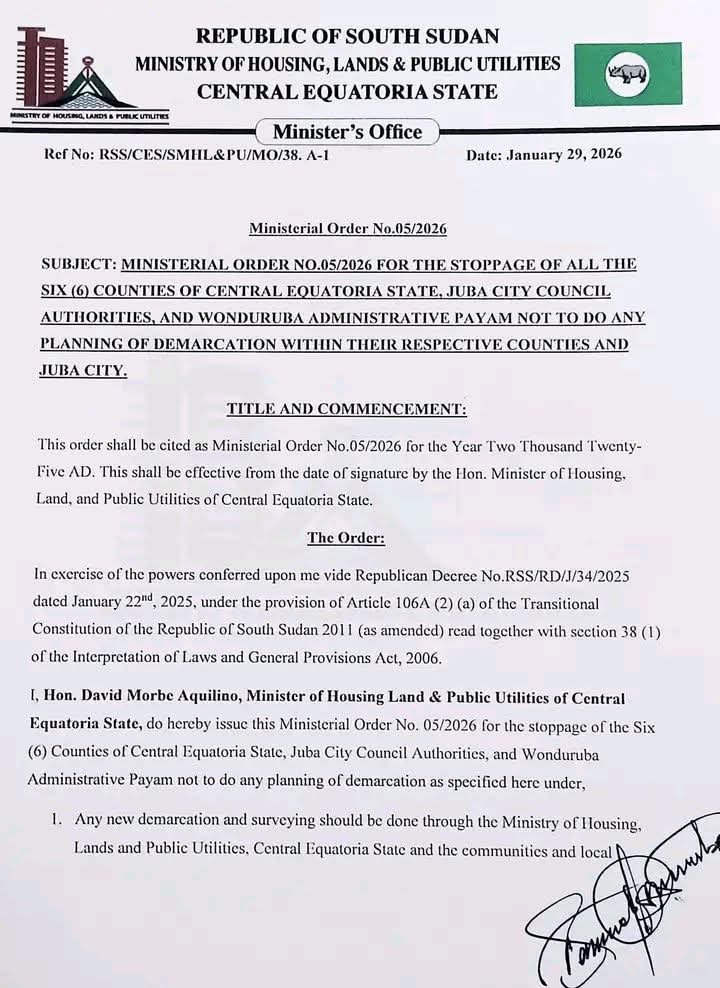
The Central Equatoria State Minister of Housing, Land, and Public Utilities, David Morbe Aquilino, has issued a sweeping directive halting all land demarcation and planning activities across the state with immediate effect.
Under the order, no county, payam, or Juba City Council authority is permitted to carry out land surveying, demarcation, or planning independently. All such activities must now be channeled through the state Ministry of Housing, Land, and Public Utilities, with the mandatory involvement of local authorities and affected communities.
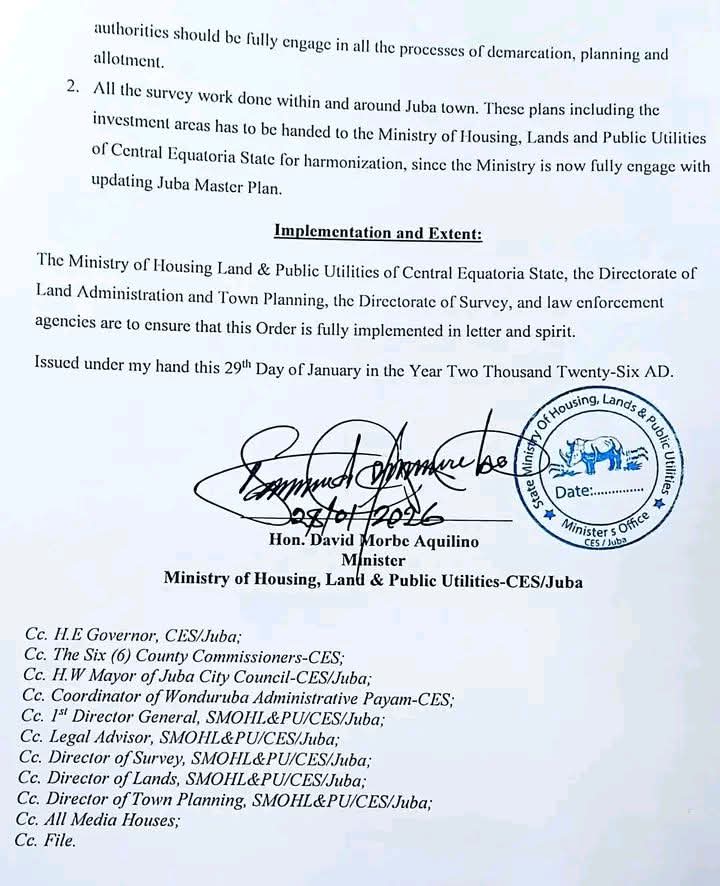
The directive further instructs that all ongoing and previously conducted survey and planning works — including those in key investment zones around Juba — be submitted to the ministry for review and harmonization to ensure alignment with state-wide planning priorities.
State officials say the move is aimed at strengthening oversight in land administration and curbing widespread land grabbing and irregular allocations that have long affected Juba and other parts of Central Equatoria. Over the years, powerful individuals and institutions have been accused of unlawfully demarcating land, evicting residents, and dispossessing legitimate owners, often triggering disputes and community tensions.
Land-related conflicts have been a persistent challenge in Central Equatoria, particularly in and around Juba, where rapid urban expansion, weak regulation, and overlapping authorities have fueled contested claims. Previous attempts by the state and national governments to rein in illegal allocations have met resistance, with critics citing selective enforcement and political interference.
The ministry also announced that it is moving ahead with plans to update the Juba Master Plan, a long-delayed framework intended to formalize urban development, guide land use, and bring order to the city’s expansion and surrounding areas.
Observers say the blanket ban could help bring coherence to land governance in Central Equatoria State if enforced consistently. However, they caution that its success will depend on transparency, community participation, and the ministry’s ability to balance investment needs with the protection of local land rights.

 and then